Julianna Hukill is an oral surgeon. For 26 years she worked in private practice. She grew up watching her father develop photographs in a home darkroom and her mother mold clay sculptures. Art was woven into her everyday life from the beginning. When her children were grown, she enrolled at the University of Arts and Design to pursue a Master of Fine Arts in Digital Design.
She is also one of the students who produced Artboard Magazine Issue 3.
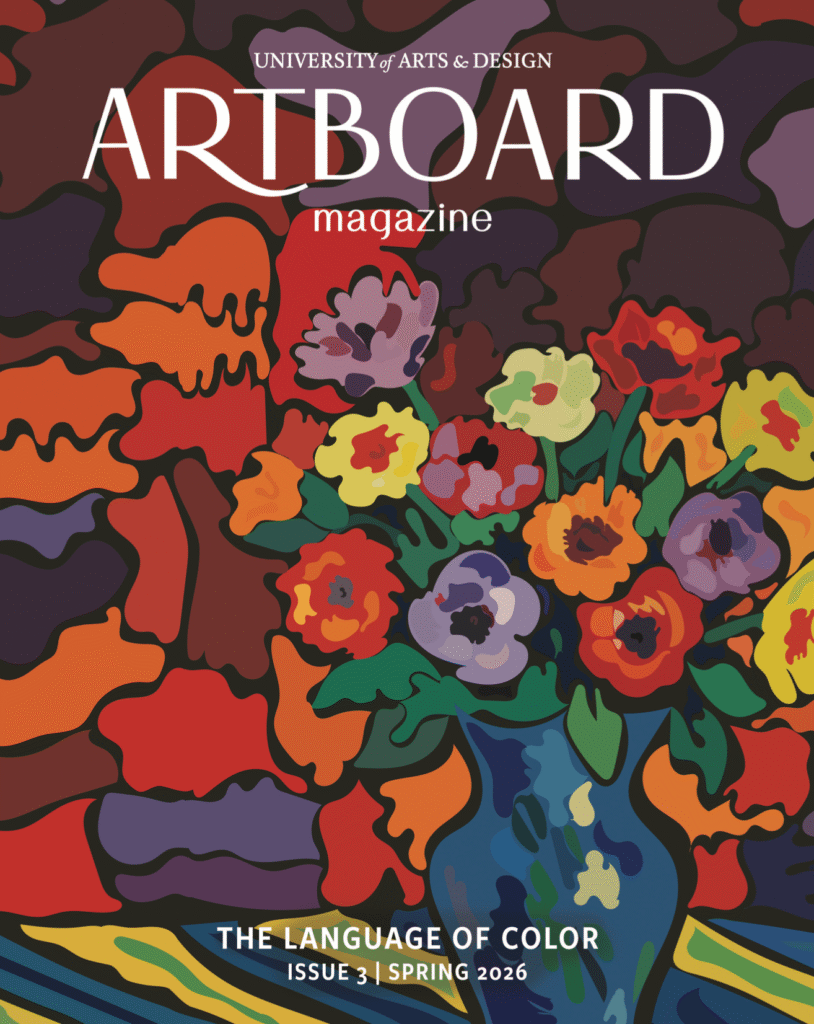
That is the kind of person who makes up the UAD student body. Working professionals, parents, career changers, and people who spent decades doing something else before deciding to take their creative life seriously. The Spring 2026 issue of Artboard is a 156-page record of what happens when those people are handed a theme, given editorial authority, and told to make something worth reading.
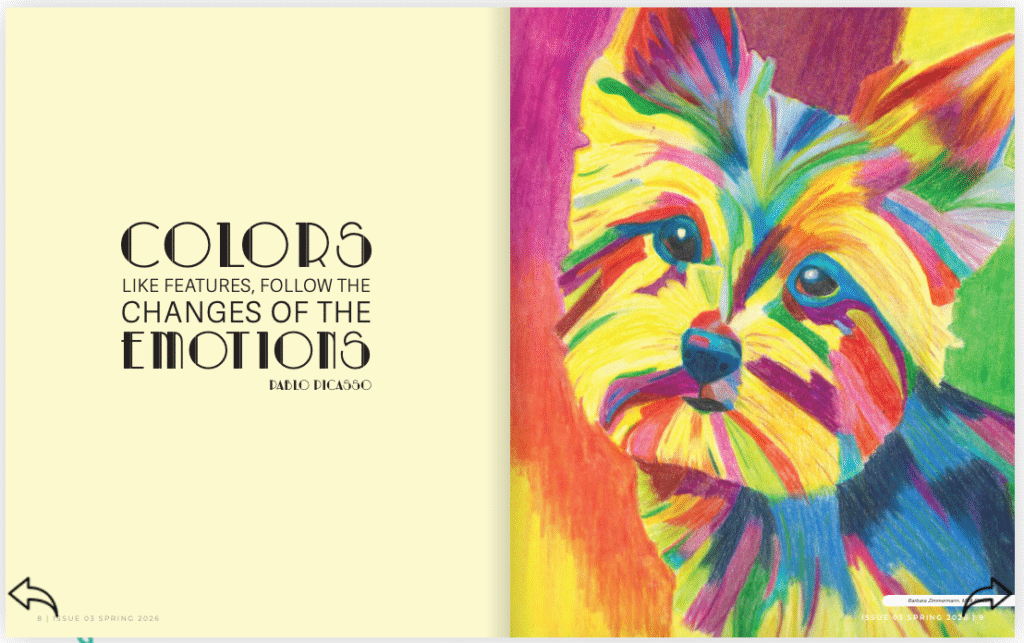
The theme is color. Specifically, why it works the way it does, how designers use it with intention, and what it communicates before a viewer reads a single word.
You can read it free at uad.education/pages/artboard. A print copy is available on Amazon.
The Students Ran This Magazine
Issue 3 was produced entirely by students in DES 608: Design Leadership and Direction. That course is not a writing class or an art class. It is a leadership class. The assignment is to run something.
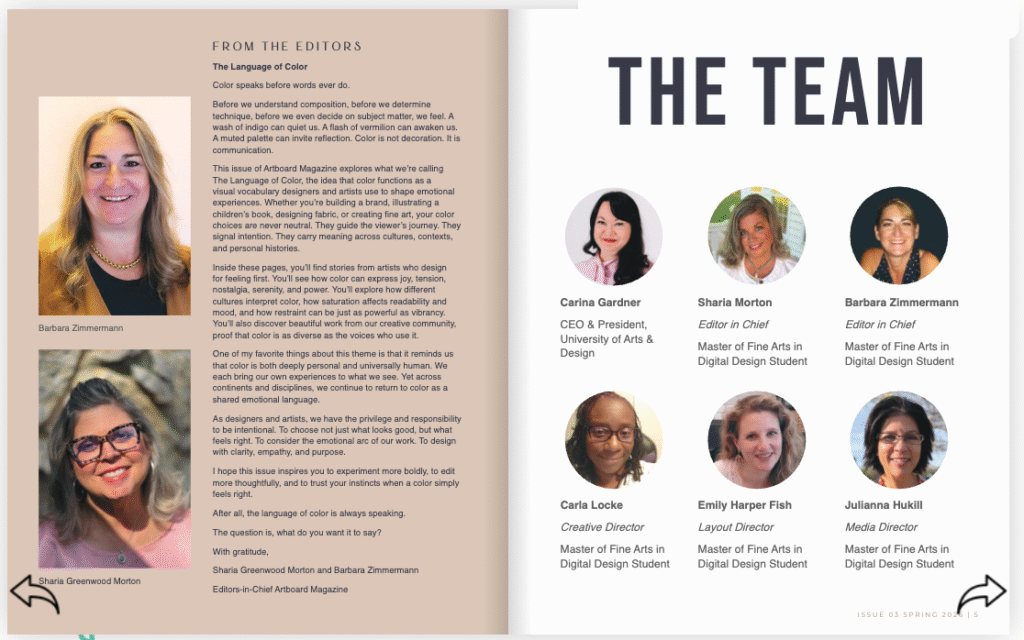
Sharia Greenwood Morton and Barbara Zimmermann served as editors in chief. Both are MFA in Digital Design students. Carla Locke was creative director. Emily Harper Fish handled layout. Julianna Hukill managed media. Every article, every editorial decision, every spread was theirs.
That is worth sitting with. These are graduate students in a fully online program who coordinated a 156-page professional publication from different locations, across a full semester, with no physical newsroom. The result does not read like a class project. It reads like a real magazine.
“This issue is more than a collection of beautiful work,” wrote Dr. Carina Gardner, Founder and President of UAD, in her letter from the Founder’s Desk. “It is a reflection of what happens when artists and designers are given both creative freedom and strategic direction.”
The Science Is in Here. So Is the Feeling.
Michelle Ward opens with a piece called Before We Have Words. She draws on a 2007 study comparing Russian and English speakers identifying shades of blue. Russian has two distinct words for light blue and dark blue. English has one. Russian speakers were measurably faster at distinguishing shades that crossed that linguistic boundary, but only when language was not otherwise occupied. When they were given a verbal distraction task at the same time, the advantage disappeared entirely. The colors had not changed. Only the availability of language had.
Ward’s conclusion is careful and specific: the brain registers color quickly. Language then reorganizes what we see into categories. Before we learn the word blue, we see a spectrum. Once we learn the word, we begin to see boundaries.
That is the kind of thinking running through this issue. It is not surface-level design inspiration. It is designers doing genuine intellectual work.
Kirstin Herman traces the color wheel from Isaac Newton passing light through a prism in 1676 through Goethe’s observation in 1810 that colors change depending on their neighbors, through Munsell’s three-dimensional color system in 1905, through the Bauhaus, and into RGB screens and CMYK printers. The color wheel most art students recognize today is not one person’s invention. It is a 400-year collaboration between physics, psychology, art, and industry.
Maile Ogden explains why mixing red and green light produces yellow while mixing red and green paint produces brown. It comes down to one idea: light adds wavelengths, pigment subtracts them. Two systems, one goal, completely different rules.
What Designers Do With Color in Practice
The issue earns its length because it does not stay theoretical. Every concept lands in actual professional application.
Emily Harper Fish writes about helping clients select paint for their homes. Her method starts before opening a paint deck, with one question: what is staying? Flooring, tile, cabinetry, stone, hardware. Paint is flexible. Those elements are not. She once worked with a client who was certain she hated green, but the marble mosaic already selected wrapped around the room in green-gray glass tiles. That single constraint changed every decision that followed.
Kristen Campbell writes for textile and fabric designers selling on Etsy and Spoonflower. Her framing is direct: beautiful color is easy. Strategic color is different. She walks through how to identify a target buyer before building a palette, how to structure a collection around anchor, supporting, and accent colors in a 60-30-10 framework, and how to test palettes in context before production. The gap between a palette that looks right on screen and one that actually works on a quilt, a pillow, or a tote bag is real, and this piece closes it.
Carolyn Raar catalogs six places designers actually find color: nature, art and design history, trend forecasting, digital tools, emotional intention, and the constraint of limitation. Her observation on the last one is worth noting. Strong palettes often come from restriction, not abundance. Limit to three to five colors and the design becomes cohesive. Expand to ten and it becomes noise.
Veronica Lopez contributes two pieces. A World Made of Color draws from her life near the ocean, watching the sea shift from jewel blue on a sunny day to deep blue-black at night to gray-blue in a storm. She built entire color palettes from a single sunset transitioning to a night sky. Architecture, Color, and Cultural Language explores how built environments carry identity and emotion through their choices of color, and why the same hue can communicate something entirely different depending on where in the world it appears.
Who These Students Are
The magazine includes formal spotlight profiles on three students, and they are worth reading as closely as the articles.
Maile Ogden is a mixed-media artist whose studio, Maile Alicia Designs, grew from a lifelong love of textiles and a promise made in an antique shop on a cross-country road trip between California and Indiana. A stranger placed a long needle and a ball of thread in her hands, introduced her to needle tatting, and told her to keep the old crafts alive and pass them forward. She has been doing that ever since. She is also a full-time caregiver, an MFA student, and a creative entrepreneur building a business around embroidery patterns, fabrics, quilts, SVG cut files, and teaching resources.
Kirstin Herman was born into a family of artists, from her great-grandfather who helped build the Antler Arches in Jackson Hole, Wyoming, to her ceramist mother and painters throughout the family. She taught high school art for eight years, graduated with a degree in art education, and is now pursuing her MFA while raising twins. She co-founded a design business called Raelene Raechelle with her mother. Her color palettes draw from the softer side of nature: muted pinks, greens, and warm neutrals.
Julianna Hukill, the oral surgeon who managed media for the issue, is graduating this year. She took up quilting as her creative anchor, particularly English paper piecing, and developed a love for watercolor and book design during her studies. The MFA gave her the confidence and framework to launch Shaylily, her design business, built around The Quilt Keepsake Book, a product she created from the conviction that quilts carry stories worth preserving.
Three very different people. Three careers built in parallel with creative lives that were always there, waiting for the right structure and support.
Julianna Hukill Went to India
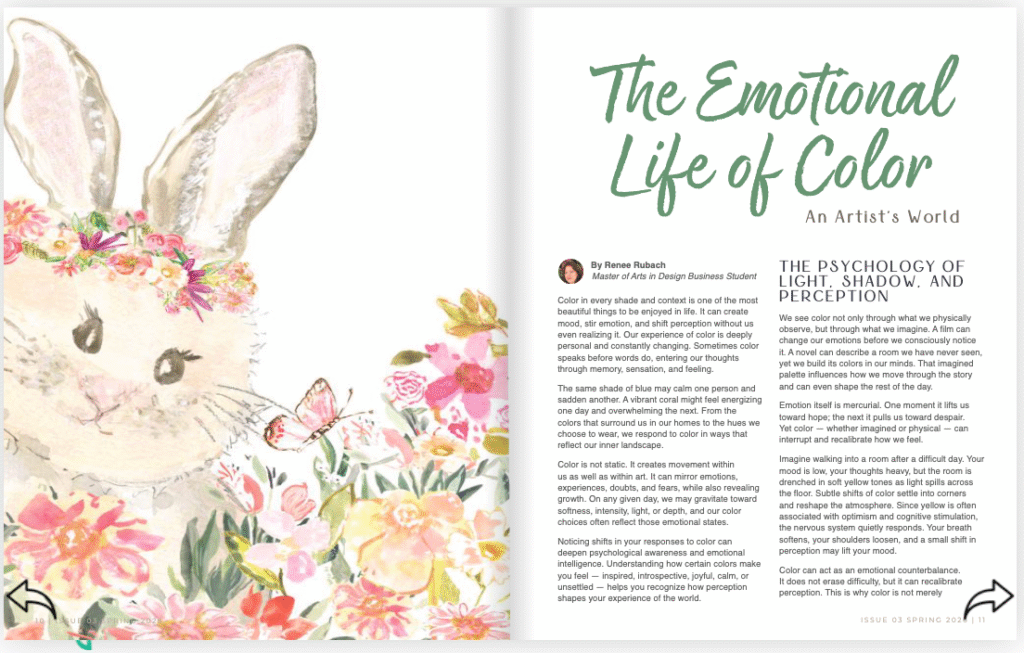
One of the most striking pieces in the issue is Handmade India: A Retreat into Traditional Textile Arts. When people asked Julianna why she wanted to travel to India, her answer was simple. As a textile designer, she wanted to see how color and fabric have been made by hand for centuries in one of the places that did it first.
She writes about stepping off the plane in New Delhi and seeing vibrant saris and colorful turbans immediately. She visited indigo dye workshops in Jaipur where fabric is dipped by hand into fermented dye, emerging a greenish-yellow that only turns blue as it meets the air and oxidizes. She documented block printers in Rajasthan carving wooden stamps with designs passed down through generations and pressing them onto fabric in repeating motifs. She visited textile museums, rug weavers tying individual knots onto looms, and pottery makers working in clay.
The piece connects traditional craft to contemporary design in a way that feels earned, because she was actually there.
The Student Gallery
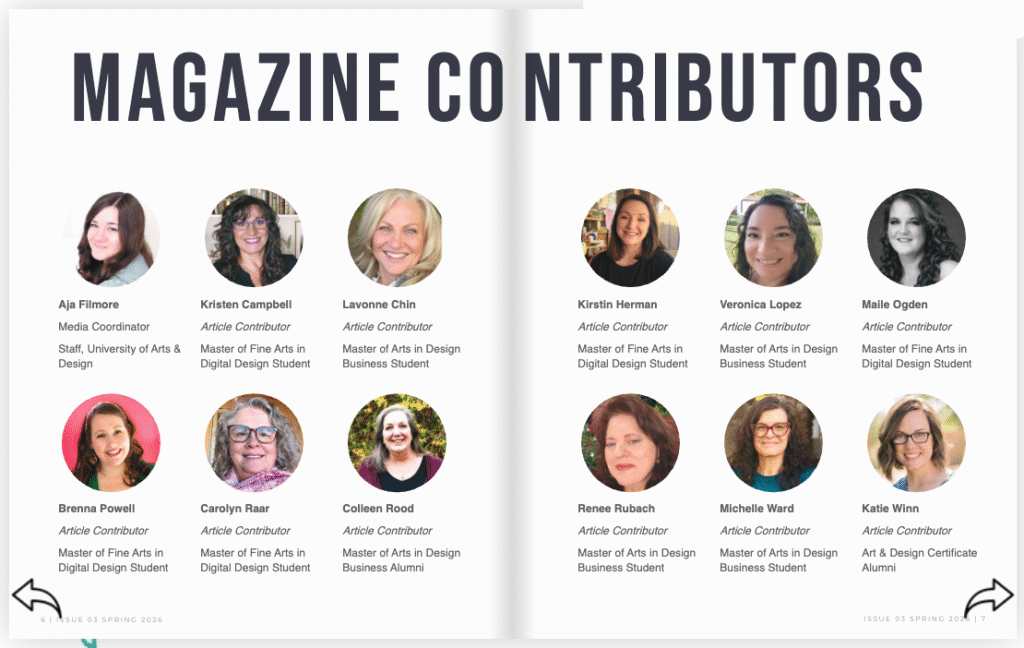
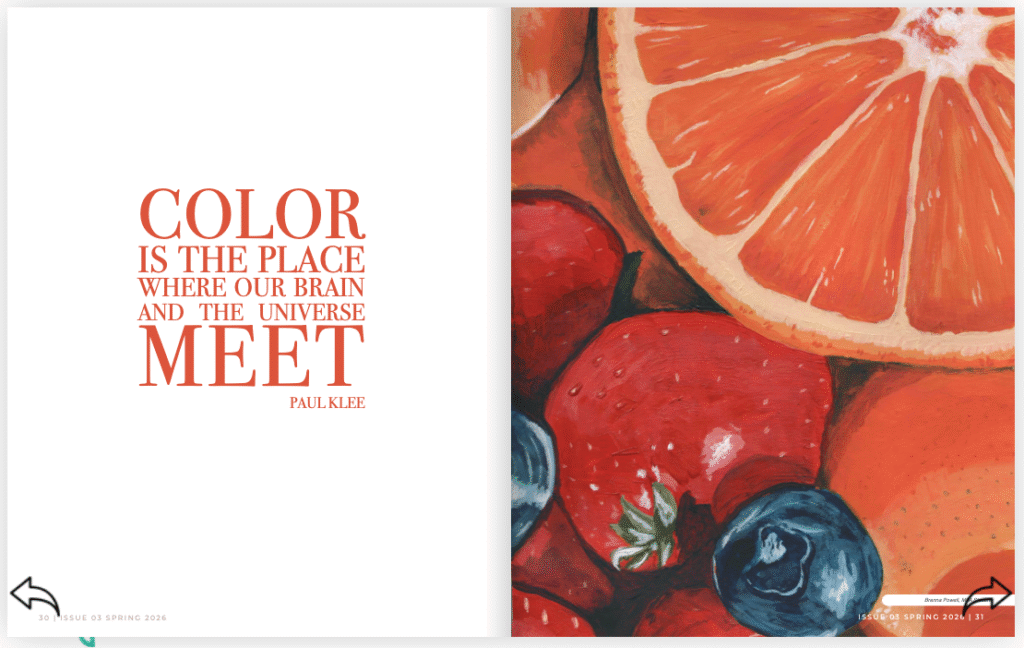
More than half the magazine is student work. Illustrations, surface patterns, typography studies, and die-cut projects fill pages 56 through 111 from students including Brenna Powell, Kirstin Herman, Kelly Burk, Carolyn Raar, Stacey Milliken, Veronica Lopez, Monica Ferdig, Angela Moen, Natalie Soderquist, Kehler Welland, Steph Furr, Sharia Morton, Carla Locke, Barbara Zimmermann, Emily Harper Fish, and others. The courses behind the work are listed: Advanced Digital Illustration, Illustrator Drawing Academy, Font Design and Innovative Typography, Die Cut and 3D Design Technology.
The work does not look like practice. It looks like what a designer would put in a portfolio or license to a manufacturer. That is intentional. UAD does not separate making from selling. Both are taught together, which is why the gallery reads the way it does.
The Diet Coke Method
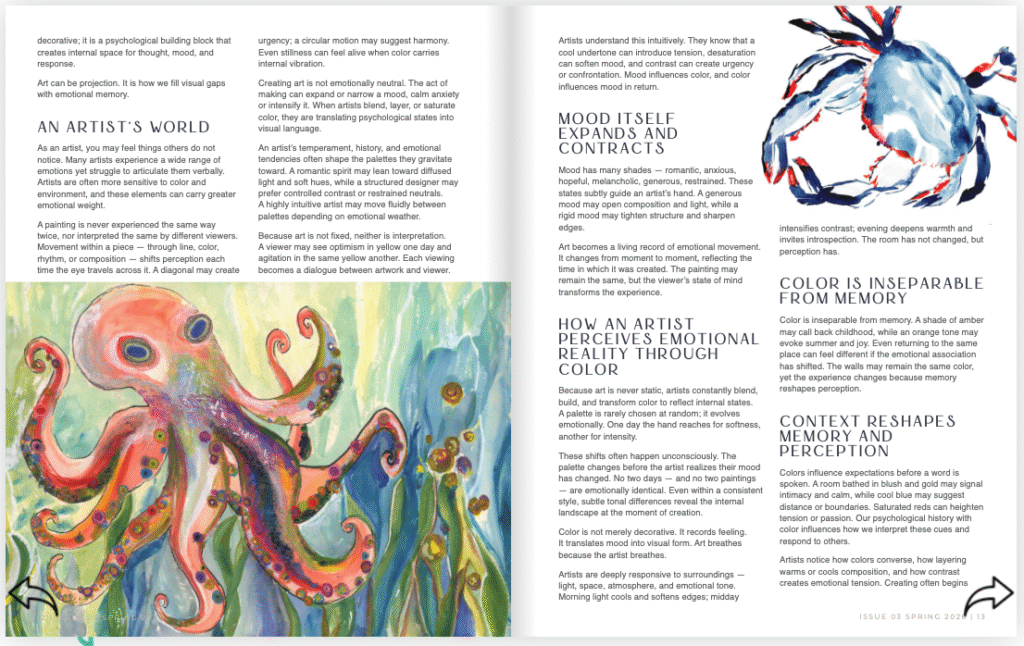
The last piece in the magazine is by Brenna Powell, an MFA student and mother of four. It is called The Diet Coke Method.
She opens every serious academic day with a Diet Coke. That is the foundation of higher education. She chronicles a single day: driving a sick child to school with a piece of white vinyl sticker from a past project still on her shirt after surviving the washer, keeping a four-year-old home to supervise productivity, selecting inspiration photos for a watercolor midterm about a bunny she describes as a very calm subject, which is almost suspiciously calm. The four-year-old watches Bluey without its usual hypnotic effects. Eventually the bunny gets painted. A third Diet Coke is opened.
She writes: being an online student at the University of Arts and Design means I get to do both. I get to make art and show up for my kids.
That is what UAD is built for. The schedule bends around a student’s life. For the people this university was designed to serve, that is not a convenience. It is the reason they are here at all.
Read Artboard Issue 3
Artboard Magazine Issue 3 is free to read at uad.education/pages/artboard. Print copies are on Amazon.
If you are a designer who wants to understand color more deeply, there is a lot in here. If you are considering UAD and want to know what the program actually produces, this issue is a more honest answer than any program page.
Frequently Asked Questions
Is Artboard Magazine free?
Yes. Every issue of Artboard Magazine is free to read online at uad.education/pages/artboard. A print copy is also available on Amazon for those who prefer a physical edition.
Who produces Artboard Magazine?
Artboard is produced by students at the University of Arts and Design. Each issue is led by a different student team. Issue 3 was produced entirely by students in DES 608: Design Leadership and Direction, with graduate students serving as editors in chief, creative director, layout director, and media director.
What programs does UAD offer?
UAD offers undergraduate certificate programs in Design Mastery, Surface Pattern Design, Digital Production, and Art and Design Business, as well as graduate programs including a Master of Arts in Design Business and a Master of Fine Arts in Digital Design. All programs are delivered fully online. You can explore them at uad.education/pages/adventure.
Can I apply to UAD if I am already working full time?
Yes. UAD is designed specifically for working creatives. Every program is fully online, and the schedule is built to bend around a student’s life rather than the other way around. Students in the program include practicing designers, parents, career changers, and professionals in entirely different fields who are building a creative practice alongside their existing work.
About the University of Arts and Design
The University of Arts and Design is an online postsecondary institution dedicated to graduate-level and certificate education for designers and creative professionals. UAD integrates design, technology, and business to prepare students for leadership and sustainable creative careers. Learn more at uad.education.
You can read Artboard Magazine Issue 2 here: https://uadblog.education/artboard-magazine-issue-2/